
How Long Do Dental Implants Last?
A Guide to Lifetime Success
How Long Can Dental Implants Last With Good Care in Pico Rivera CA
The promise of a permanent tooth replacement is a powerful one. With over 3 million dental implants placed each year in the U.S., it’s clear that patients are seeking a durable, long-term solution to tooth loss. You’ve likely heard the common claim that with proper care, a dental implant can last a lifetime. But what does “proper care” truly mean, and is longevity really that simple?
While many articles frame implant longevity as a simple function of a patient’s brushing and flossing habits, this perspective is dangerously incomplete. The truth is that a “lifetime” implant is not a static product you buy, but the outcome of a proactive partnership. It’s a dynamic biological system co-managed by you and your clinical team from day one.
This guide moves beyond the basics to reveal the collaborative strategy required for decades of success. We’ll deconstruct the components, uncover the hidden threats, and redefine what a genuine long-term maintenance plan looks like.
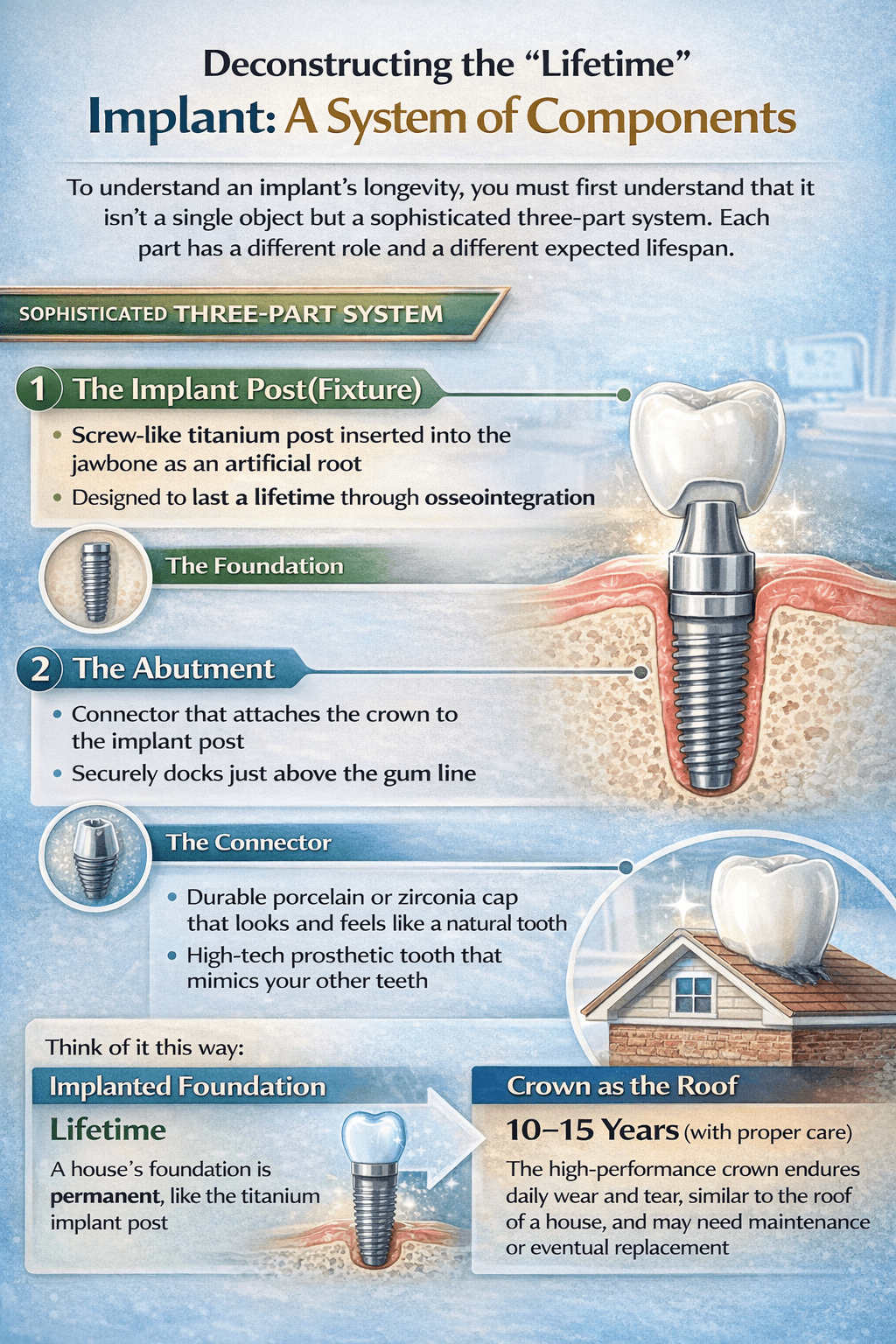
Deconstructing the “Lifetime” Implant: A System of Components
The Implant Post (Fixture): This is the foundation. A screw-like titanium post is surgically placed into your jawbone, where it functions as an artificial tooth root. Through a remarkable biological process called osseointegration, the bone fuses directly with the biocompatible titanium. This titanium post is the part of the system designed to last a lifetime.
The Abutment: This is the connector. The abutment is attached to the top of the implant post and protrudes just above the gum line. It serves as the secure docking point for the final crown.
The Crown (Prosthetic Tooth): This is the visible, functional part of your new tooth. The crown is a piece of high-tech restorative dentistry, typically made of durable porcelain or zirconia, and is meticulously crafted to match your other teeth. While incredibly strong, it is subject to daily wear and tear from biting and chewing.
Think of it this way: the implant post is the permanent foundation of a house, while the crown is the high-performance roof. The foundation should never need replacing, but the roof, which endures daily environmental stress, will eventually require maintenance or replacement after many years of service. Most dental crowns last 10 to 15 years, though with excellent care, this can often be extended.
The Pre-Care Imperative: Success Is Determined Before Surgery Begins
What many people don’t realize is that the most critical factors for long-term implant success are established long before you begin your at-home oral hygiene routine. The expertise of your clinical team and the quality of your initial treatment plan are the bedrock of implant longevity. Research confirms that well-planned and cared-for dental implants offer survival rates comparable to or better than other tooth replacement options, placing immense importance on this initial phase.

Critical Pre-Operative Factors:
Comprehensive Jawbone Assessment: Your implant needs a solid foundation. This requires a thorough evaluation of your jawbone health and density, often using a CT scan. If the bone is insufficient, procedures like bone grafting or a sinus lift may be necessary to create an adequate anchor for the implant post.
Precision Placement: The implant’s exact position, angle, and depth are crucial. Proper placement ensures the forces from chewing (occlusion) are distributed correctly, preventing excessive stress on the implant. Modern techniques like computer-guided surgery help achieve this with incredible accuracy.
Beyond Plaque in Pico Rivera: The Real Threat to Your Dental Implant
Here’s how it progresses:
1. Peri-mucositis: This is the initial stage, equivalent to gingivitis around a natural tooth. It’s caused by plaque buildup at the gum line, leading to inflammation, redness, and bleeding. At this stage, the condition is reversible with professional cleaning and improved oral hygiene.
2. Peri-implantitis: If peri-mucositis is left untreated, it can advance to peri-implantitis. The inflammation progresses deeper, destroying the supportive jawbone that has fused to the implant. This bone resorption is irreversible. The gum may recede, pockets can form around the implant, and eventually, the implant will become loose and fail.
Because dental implants don’t have nerves, peri-implantitis can develop and cause significant damage without any pain, making a proactive monitoring strategy essential.
Your Proactive Care Plan: Co-Managing Your Implant for Decades
Protecting your investment requires moving beyond the mindset of simple “checkups” and adopting a long-term, co-managed care plan. This partnership involves dedicated at-home care from the patient and specialized monitoring from the dental team.


The Patient’s Role: Daily Maintenance
Diligent Brushing: Use a soft-bristled toothbrush and non-abrasive toothpaste to clean the crown and around the gum line twice a day.
Specialized Flossing: Cleaning between the implant and adjacent teeth is critical. A water flosser, implant-specific floss, or an interdental brush is often necessary to effectively remove plaque from this area.
Manage Systemic Health: Conditions like uncontrolled diabetes can impair healing and increase infection risk. Lifestyle choices also matter; smoking dramatically reduces blood flow to the gums, hindering healing and increasing the risk of peri-implantitis.
Address Bruxism: If you grind your teeth (bruxism), the excessive force can damage the crown or loosen the implant screw. Your dentist may recommend a custom night guard to protect your implant and natural teeth.
The Pico Rivera Clinical Team’s Role: Professional Monitoring
Your long-term follow-up care is more than a standard cleaning. It’s a dedicated surveillance program to protect the bone-implant bond.
Periodic Radiographs: X-rays are taken at regular intervals (e.g., annually) to monitor the bone level around the implant post, allowing for early detection of bone loss.
Probing Depths: A hygienist or dentist will gently measure the depth of the gum pocket around the implant. Deepening pockets can be an early warning sign of inflammation and bone resorption.
Professional Dental Cleaning: Your hygienist will use specialized tools made of plastic or titanium that can effectively clean the implant, abutment, and crown without scratching their surfaces.
Stability and Occlusion Checks: The dentist will manually check the implant for any signs of mobility and assess your bite to ensure forces are distributed evenly.

Dental Implants by the Numbers: What Does the Research Say?
The concept of an implant being a lifelong partnership is heavily supported by clinical data. Long-term studies show that success isn’t guaranteed but is highly probable with the right approach. For instance, a major 20-year meta-analysis found a mean implant survival rate of 92%. However, when researchers used statistical methods to account for all implants placed, including those in patients who dropped out of the study, the estimated survival rate adjusted to 78%—a more realistic, though still very high, figure.
Crucially, the same research concludes that implant failure causes are “multifactorial,” reinforcing that success is more complex than just patient care alone. It is a combination of surgical skill, patient health, biomechanics, and long-term maintenance.
Answering Your Top Questions About Dental Implants
Can a dental implant truly last a lifetime?
What is the 3/2 rule for dental implants?
What does no one tell you about dental implants?


What are the downsides and risks of dental implants?
Conclusion: A Lifetime Implant is a Shared Achievement in Pico Rivera
By understanding the implant as a dynamic biological system, prioritizing expert placement, and committing to a proactive, co-managed maintenance plan, you can transform the popular claim of a “lifetime” implant into your personal reality. Your new tooth is not just a cosmetic restoration; it’s a long-term investment in your health, confidence, and quality of life that deserves to be protected by a shared commitment to excellence.
